



Family
A Tribute to My Father
Fifty years ago today, Kent Keller's father died at 55. A B-17 pilot, a POW, a Kansas farm boy — and the four things he left behind.

Today, September 9, 2026 is an important marker in my life. My father, George Keller, passed away 50 years ago today. Fifty years. A half-century. That means he has been gone from my life about two-and-a-half times as long as he was in it. That could cause me to feel down and depressed … but I have a rather different perspective about it.
My dad was my number one role model and mentor in life. He didn’t set out to be that intentionally, probably would have been surprised to know I thought that. He was a quintessential Midwesterner and member of the Greatest Generation: quiet, unassuming, honest, good-natured, down-to-earth, which makes sense considering his birth, childhood and early life in small-town pre-Depression Kansas.
He was born at home in the house his family rented that was actually on land inside a Potawatomi Indian reservation in eastern Kansas. Along with his parents and eventual five siblings, he grew up on farms in various small towns in Kansas in what today we would consider extreme poverty: no central heat or air conditioning, no indoor plumbing; the family bathroom was an outhouse. Imagine that on a sub-zero Kansas winter morning — waking up before dawn to take care of your farmhouse chores (he was the oldest boy, and they pretty much had to raise livestock and crops to stay alive). After that he had to get ready for school.
After helping get his family through the Great Depression, he headed off to college at Emporia State College (now University) where two very important things happened: first, he met my mother; second, like millions of other young American men he signed up to join the fight against the Nazis and the Axis powers, entering the Army Air Corps (forerunner of the Air Force).
He qualified for flight training, becoming a B-17 pilot. He married my mother just before shipping out to Glatton, England where he and his fellow pilots and airmen were assigned to the 457th Bombardment Group, part of the Eighth Air Force. His crew was on its sixth mission, bombing Hitler’s war-making machinery to rubble when they were shot down. The entire crew survived, bailed out, were captured and taken prisoner by the Germans.
Pilot wisdom: “If you must bail out, try not to land in an area you just bombed. They don’t like it.”
He spent the rest of the war in a couple different POW camps where they were eventually liberated by General Patton’s Third Army. Dad made it home, reunited with my mother, and they set about rebuilding their lives and raising a family of three boys, of whom I am the youngest. (He also flew in the Korean War before I was born.)
My father spent 24 years in the Air Force before retiring as a Lt. Colonel. Like most WW II veterans, he rarely spoke of his experiences in that war (or Korea). I got the sense most of them just wanted to put it all behind them and live the rest of their lives in peace. What little my dad said about it downplayed the horrors he must have seen and gone through himself.
I wasn’t old enough or wise enough to ask him to tell me more about his experiences during wartime — I don’t know if he would have or not anyway, but I never thought to ask him. And then, when I was 19 and had just started my second year of college, suddenly, at age 55, he was gone and there was no more asking. It is one of my greatest regrets in life.
Don’t misunderstand: my father wasn’t a perfect, sinless human being. He had his flaws, and he and I did not always get along. Sometime around 14 or 15 I suddenly acquired great knowledge and wisdom and my parents became very ignorant. During those few years my dad and I had some u-g-l-y interactions. If he had been a violent man he probably would have spun my head around a time or two, and I might have deserved it. But fortunately, by God’s grace (and my dad’s own patient nature), by the time I was around 18 and graduated from high school he and I were back on good terms.
Mark Twain once said:
When I was a boy of 14, my father was so ignorant I could hardly stand to have the old man around. But when I got to be 21, I was astonished at how much the old man had learned in seven years.
I can definitely relate.
No, my father wasn’t perfect. Even so, he left me a priceless heritage in his example and the way he raised me. So today, 50 years after he passed away, I write this as a tribute to him.
I would summarize his legacy in my life as follows:
Character
A Kansas farm boy who grows up to be a war hero — he never thought of himself that way and would not like me calling him that, but that’s how I see it — fighting the most serious threat to world freedom humanity had ever faced up to that time…. He survives the war, barely, then returns home to simply pick up where he and his wife left off, raising a family, helping rebuild a nation. He never bragged about what he had done, never called attention to himself for his accomplishments and sacrifices … he just saw it as doing his duty, answering his nation’s call in a time of great need. One of millions of young men who did something similar, it’s why they’re called the Greatest Generation. It’s not like they did that much … they just saved the world. God bless them one and all.
Courage
Again, he would never have described himself as courageous … but what else do you call it when a 23-year-old man climbs into the cockpit of an enormous war-bird over and over again to take part in missions that often had a fifty-percent kill rate? He and all those millions of young men answered their nation’s call and threw themselves into the war machine, knowing full well there was a good chance they might never return. Can you imagine? Could you do that? I’m not at all sure I could.
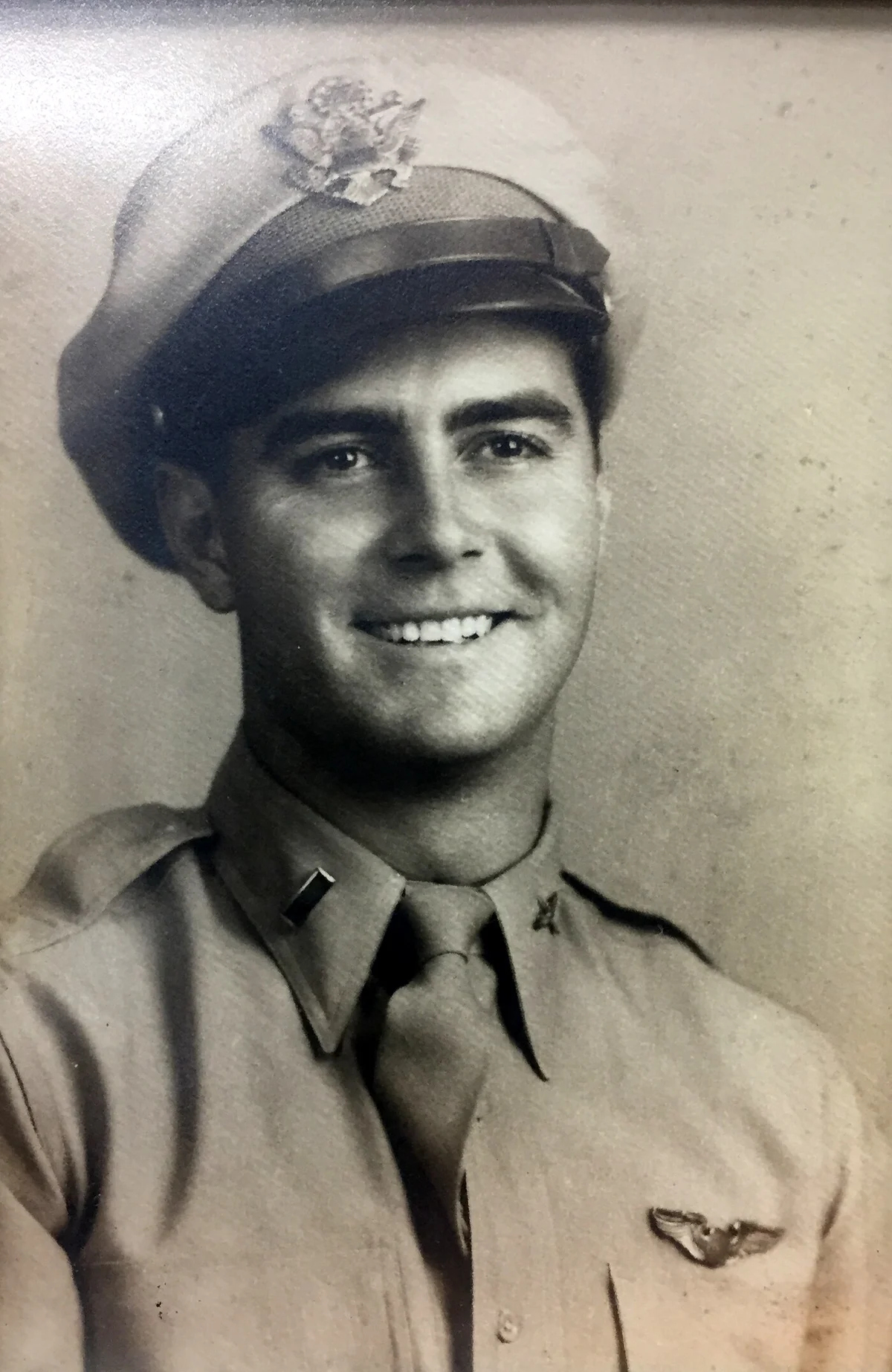
George Keller, Army Air Corps — the pilot’s wings on his chest.
That’s why I keep a poster of a B-17 on the wall of my office. Any time I think I’m having a rough day, I look at that poster, think of my dad at 23, and tell myself, “Suck it up, wimp, and do your job. He certainly did.”
Calm
My father was incredibly calm in the face of difficult circumstances, including his own health problems, which were numerous and very serious. I watched him basically walk himself into the hospital, twice, in the midst of having a heart attack. I guess when you’ve had a perfectly good airplane shot out from underneath you over enemy territory, other problems appear rather minor in comparison. Today I try to remain calm like he did when challenges arise.
Compassion
My dad was a very kind man. He had a love for just about all living things, including plant life and animals. Again, I guess when you’ve seen as much suffering and death as he must have witnessed, you either become desensitized to it or you learn to appreciate the beauty, and the fragility, of life. He chose the latter.
A few days after he died (in Birmingham, AL where we lived at the time), we flew his body back to Kansas to be buried there. I delivered his eulogy at his memorial service. Here is part of what I said about him, paraphrasing what Ted Kennedy said about his brother Robert at his memorial service:
My father need not be idealized in death beyond what he was in life, but be remembered simply as a good and decent man, who saw wrong and tried to right it, saw suffering and tried to heal it, saw war and tried to end it.
My father died 50 years ago today. Fifty years. A half-century. His life span was only 55 years, four months and four days … But he lives on in my memory, and in what he accomplished in his relatively short life, and the example he set for me. How he lived is a priceless legacy he left me, as well as what I in turn try to pass on to my wife and children.
Thanks be to God, I hit the parental jackpot with my mom and dad. I didn’t really recognize that until I started working with teenagers and their families, and then as a pastor dealing with all kinds of people: young and old, wealthy and poor, rural and urban, etc. Now I realize how blessed I was and am to have the parents I had.
So today as I mark 50 years since I said goodbye to my father, I am not sad or depressed. I am profoundly grateful to my heavenly Father for the life and legacy of my earthly father, George Keller, and I look forward to seeing him again one day when I can tell him that face to face.
Pastoral writing from the team at Christchurch Miami — a faith family on mission in Kendall, Miami.