


History
Top Ten Ways the Reformation Changed the World
Sola Scriptura was the "time bomb" that set off the Protestant Reformation. Here are ten ways it reshaped education, science, government, and the world you live in today.
The first and most important of the principles that drove the Protestant Reformation is the doctrine of Sola Scriptura – Only Scripture:
The belief that the Bible is our only infallible rule and guide in matters of faith and practice. As followers of Christ we acknowledge the authority of the Bible over all else, including the Church and its traditions. This, Sola Scriptura, was the “time bomb” that set off the other ripples that follow. Here are in my opinion the Top 10 ways the Protestant Reformation has
changed the world – and continues to impact us today.
Note: These are not listed in order of importance, but rather in loosely chronological
order of how they developed following Martin Luther’s posting of the famous 95 Theses
on the door of the Wittenberg cathedral on October 31, 1517 – 508 years ago.
*****
1. Sola Fide – Only faith: Justification by faith alone (Romans 1:16-17): The truth that rocked Luther’s world, and then the rest of the western world, is that we
are not justified (made right in God’s eyes) by our works – particularly the buying
of worthless pieces of paper called indulgences. Rather, we are justified *by the
grace of God* through faith in Christ alone. Luther’s revolution – which is really
just a reclamation of a core biblical doctrine, found throughout the Scriptures (see
especially Ephesians 2:8-10) – shattered the established Church’s stranglehold
on the people (first in Germany, then all over Europe) and set ablaze the
revolution that became known as the Protestant Reformation.
2. The imago dei (image of God) in every person (Genesis 1:26-28): Not only the king, the prince, the nobility; not just the Pope, cardinals, bishops – every
person is created in the image of God and worthy of being treated with respect
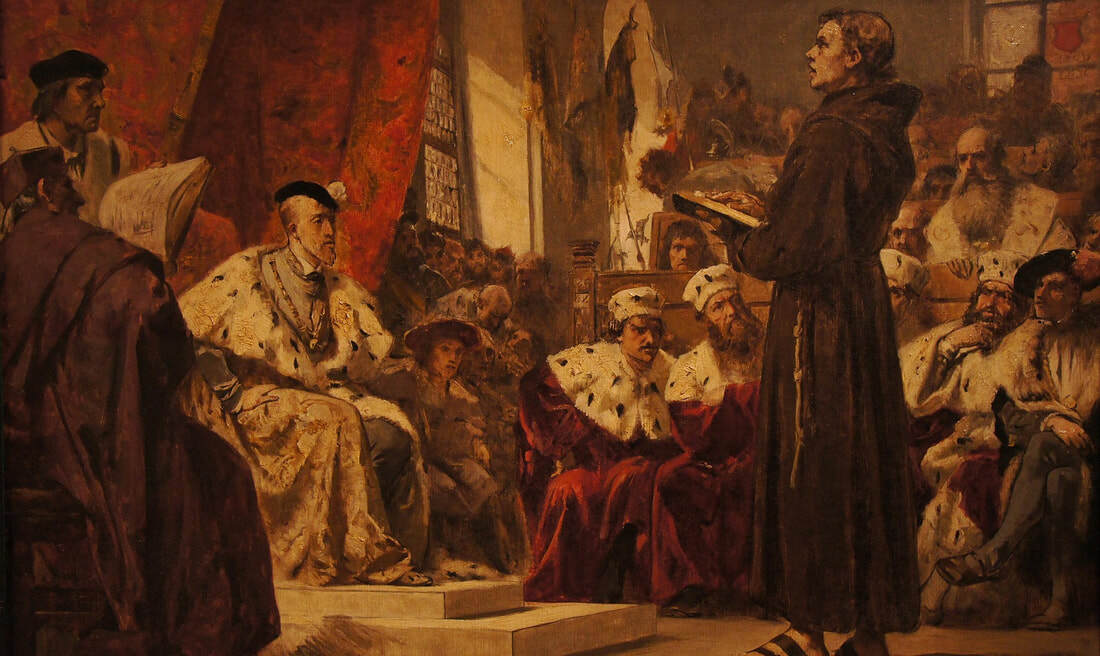
and dignity. When Luther stood up to the council at Worms, Germany, it was the
first time a common man challenged the powers of Church and State … and lived
to tell about it. In doing so he planted a time bomb that would blow apart the Old
World, the Old Order and open the doorway to the future. This doctrine would
eventually lead to the end of human slavery throughout the Western world as
well as advances in human and civil rights everywhere the Gospel goes.
3. The priesthood of all believers (1 Peter 2:9-10): According to the Bible, the priesthood is not exclusive to just the official, Church-ordained priests. (In the Old Testament, yes; in the New Testament, no.) We no longer need to go to a “priest” to confess our sins, receive absolution – nor engage in unthinking repetitions of
“Hail Mary’s” and “Our Father’s.” This also did away with the idea that only the
priest could receive the elements during the Lord’s Supper and opened it so that
everyone who professes Christ as Lord could participate (see 1 Cor. 11:23-34).
4. The doctrine of vocation (Genesis 1:26-28; Colossians 3:23-24): All work that is legal, ethical and moral is good and legitimate in God’s eyes – not just the
“holy” work of the priest and the bishop. This gave tremendous dignity to the
common man doing common jobs – farmers, miners, tradesmen, craftsmen, etc.
This in turn led to the:
5. Protestant work ethic and capitalism (Colossians 3:23-24): Whatever your opinion of capitalism, it has led to the highest living standards and the greatest
technological advances in human history. How else can you explain a relatively
small, comparatively young nation, the United States of America, going from
being a loosely aligned group of colonies … to the most prosperous nation and
greatest military power the world has ever seen … to being able to put a man on
the moon … in less than 200 years? At the founding of this nation it was
overwhelmingly (98 percent) Protestant, and predominantly Calvinist in belief.
These things, combined with a belief in a shared moral responsibility that work
should be done in honest and ethical ways, have led to unprecedented material
wealth, unparalleled generosity and the emergence of the middle class. It is
worth noting that the Reformers, especially Calvin, always looked at material
prosperity as a means of being able to be generous toward the work of the
Church and the care of the less fortunate.
6. Education (Psalm 119; Colossians 1:28-29): Because the Reformation was so heavily Bible-centric, reading it became essential to the spread of the Gospel and Reformed doctrines. This led to a tremendous increase in literacy all over Europe and beyond. Thanks to Herr Gutenberg’s remarkable invention, the movable-type
printing press, pamphlets, treatises and books became widely available. In
Geneva, Switzerland John Calvin instituted the first widespread “public” school
system whereby all children, not just the wealthy and the nobility, could receive
an education. This also spurred an increase in literacy, which led to the
widespread reading of the Bible, which in turn helped fuel the unstoppable
spread of the Reformation. (It might be of interest that New England, founded
and heavily influenced as it was by the ferociously Reformed Puritans, had a
literacy rate in the mid-19th Century of 95 percent … much higher than it is today.)
7. Bible translation / language itself (John 1:1): Before the Reformation the people did not have access to the Bible in their own languages. The only translation available was in Latin, and nobody read Latin back then, either. Martin
Luther’s German translation of the Bible revolutionized the German language.
Shakespeare, in his plays written during the 1590’s, quoted from Calvin’s
Geneva Bible. The King James Bible had much the same impact on the English
language as Luther’s translation on German; we still use scores of phrases
(“prodigal son,” good Samaritan,” “my brother’s keeper,” etc.) from the King
James Version today. Translation of the Bible into hundreds and hundreds of
indigenous languages has led to more cultures having a written alphabet, and
hence becoming literate, than any other factor.
8. Rise of modern science (Genesis 1; Psalm 19:1-2): The modern notion of “science” grows from, and only from, a biblical worldview – and it began only in post-Reformation northern and western Europe. Oxford professor John Hedley
Brooke says Christianity has influenced the development of modern science in
the following ways:
“1. Christian teachings have served as presuppositions for the scientific enterprise;
-
Christian teachings have sanctioned science;
-
Christian teachings supplied motives for pursuing science; and
-
Christianity played a role in regulating scientific methodology.”
Popular opinion and prevailing secular educational attitudes notwithstanding, science grew not in a climate of “warfare between science and religion,” but rather primarily as a “debate among Christians over the best way to conceptualize God’s role in the world – a debate
over how to construe divine action in a world increasingly understood to operate
by natural law.” Most of the early scientists, including Johannes Kepler, Rene
Descartes, Blaise Pascal, Isaac Newton, Louis Pasteur, Michael Faraday and
many others were either professing Christians or at least operating under a
biblical worldview.
9. Limited government (Romans 13:1-7): The Reformers understood that our rights come from God, not the government, and that the civil government was instituted by God not to provide for all our needs nor to regulate all our activities, but to perform a few basic functions: 1. To restrain evil; 2. To promote the
common good; 3. To execute judgment on those who do evil. They taught that
those who are in authority derive their just powers from the people and that they
are accountable to God for how they conduct themselves while in office. Calvin
said that as such, civil governments are under a covenantal obligation before
God to behave in a moral manner, just as individuals are. If the civil authority is
or becomes immoral and ungodly, they can and should be removed. These
beliefs and principles were obviously extremely influential for the settlers and
Founding Fathers of this nation. The United States is only the second nation ever
founded upon a covenant – Old Testament Israel being the other.
10. Separation of Church and State (Exodus 18:17-27): At the time of the Reformation, the established Church largely dominated the State, to the
detriment of both. It was an unholy alliance, leading to rampant, unrestrained
corruption in both … and the people suffered as a result. The Reformers taught
the two must be separate, and that the Church’s job was not to dictate matters to
the State, nor to serve as its lackey, but to be its conscience and hold the State
accountable for its actions. Martin Luther King, Jr.’s *Letter From A Birmingham
Jail* is a magnificent recent restatement and reaffirmation of these principles. This
is not to imply by any means that the two entities are not to interact with or
overlap with one another, as many today would have us believe, but to say that
neither should dominate or control the other. They each have their God-given,
God-ordained spheres of influence and responsibilities. The Founding Fathers,
while not all Bible-believing Christians, clearly understood this. That’s why
freedom of religious expression is the first right enshrined in the Bill of Rights.
*****
The Protestant Reformation in essence created the modern world. I am aware that the Reformers, including Luther and Calvin, were deeply flawed men (especially from our 21st Century, “enlightened” Western point of view), and that the modern world is not without its flaws and sins. Still, in comparison with every other culture, society, tradition etc. it stands head and shoulders above in terms of the opportunities, freedoms, and
blessings it offers. If you doubt that, ask yourself – why, even today, are so many willing
to risk their lives and even the lives of their entire families to get to the United States?
And it all began with one man reading the Bible.
I am much indebted to numerous sources, including: Institutes of the Christian Religion, John Calvin*; How Now Shall We Live?,* Charles Colson*; The Legacy of John Calvin,* David Hall*; The Emergence of Liberty in the Modern World,* Douglas Kelly*; Martin Luther,* Eric Metaxas*; The Soul of Science,* Nancy Pearcey and Charles Thaxton*; No Place for Truth,* David Wells; and Breakpoint Ministries.
Frequently asked questions
What was the most important doctrine of the Protestant Reformation?
How did the Protestant Reformation lead to public education?
What is the priesthood of all believers?
What is the doctrine of vocation?
How did the Reformation influence the American Founders?
Pastoral writing from the team at Christchurch Miami — a faith family on mission in Kendall, Miami.