



Foundations (Week 11)
Tower of Babel · Resources
Genesis 11
Watch & Listen
Summary
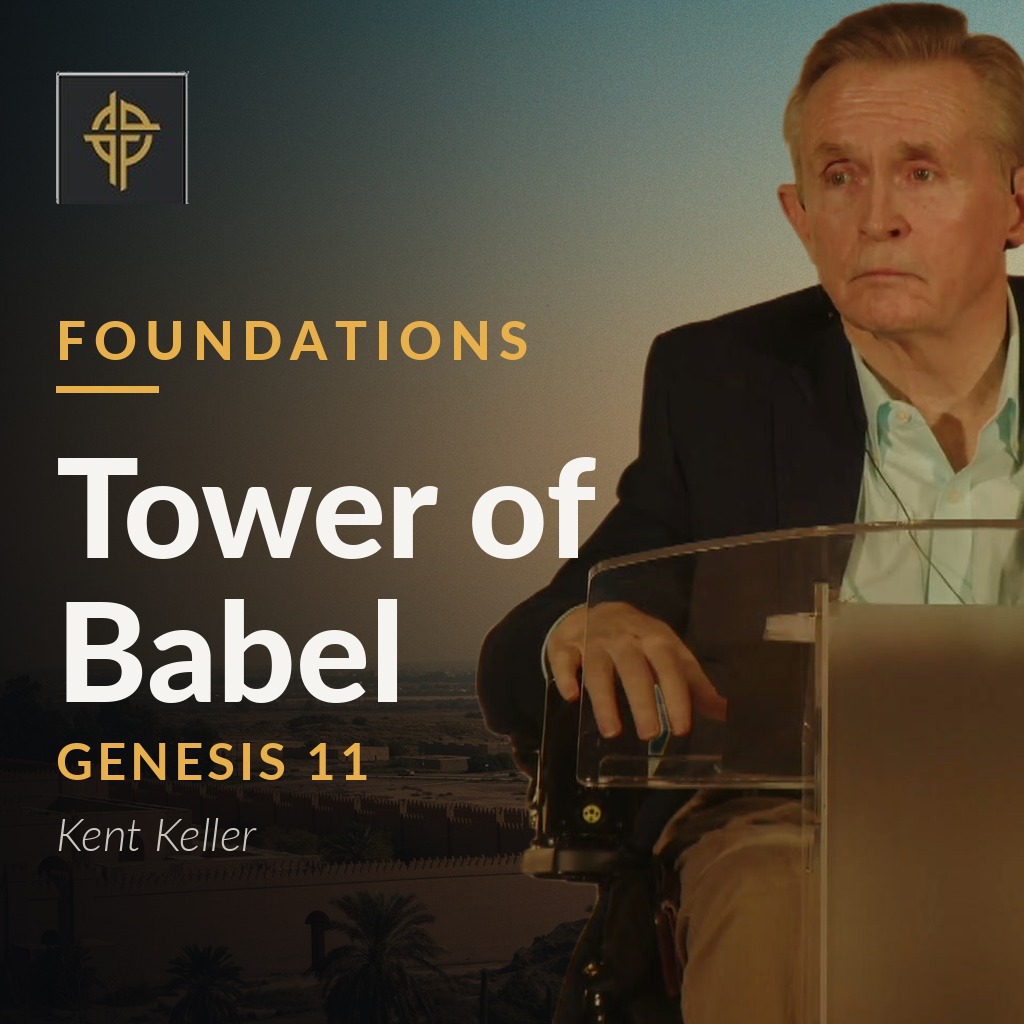
Kent Keller opens Genesis 11 with Augustine's tale of two cities. The Tower of Babel is the first city of man — built on human pride, erected as a temple to the worship of self, and chartered on the Enlightenment creed that man is the measure of all things. Its builders wanted to make a name for themselves; God's answer is to make Abram's name great instead. Kent closes with John's vision of the new Jerusalem coming down from heaven — the city God builds and no one can destroy — and the question it leaves: where is your citizenship?
Sermon Outline
- 1
A tale of two cities ▶ 0:00
Augustine's City of God — the city of man formed by love of self, the city of God by love of God — and Genesis 11 as an early, primitive city of man.
- 2
A foundation of human pride ▶ 8:03
C.S. Lewis's two kinds of pride; Babel built on hubris; GTA VI's Miami and Philippians 3; the Hebrew shem — a name of their own making.
- 3
A temple for the worship of self ▶ 16:07
Technology is a wonderful servant and a lousy God; 'Be still, and know that I am God'; the domed stadium with a retractable roof we open only in crisis.
- 4
Man is the measure of all things ▶ 21:55
The Enlightenment charter; a 300-foot tower heaven was not threatened by; God comes down, confuses language, and grieves; the world on loan as a stewardship.
- 5
A city built by God ▶ 29:05
Babel makes a name; God makes Abram's name great. What man builds, man destroys — but John's new Jerusalem comes down from heaven and cannot be destroyed. Where is your citizenship?
Key Points
- Augustine framed history as two cities: the city of man, formed by love of self to the point of contempt for God, and the city of God, formed by love of God.
- Babel is built on hubris — the pride that is the opposite of humility, not the honest pride of a job well done.
- The builders wanted to make a name (shem) for themselves; one chapter later God makes Abram's name great instead.
- Technology is a wonderful servant but a lousy God; the city of man is a temple to the worship of self.
- What man builds, man destroys, but the city of God comes down from heaven and cannot be destroyed.
Quotable Moments
Scripture
Genesis 11 (ESV)
Genesis 11 (ESV) Now the whole earth had one language and the same words. And as people migrated from the east, they found a plain in the land of Shinar and settled there. And they said to one another, "Come, let us make bricks, and burn them thoroughly." And they had brick for stone, and bitumen for mortar. Then they said, "Come, let us build ourselves a city and a tower with its top in the heavens, and let us make a name for ourselves, lest we be dispersed over the face of the whole earth." And the LORD came down to see the city and the tower, which the children of man had built. And the LORD said, "Behold, they are one people, and they have all one language, and this is only the beginning of what they will do. And nothing that they propose to do will now be impossible for them. Come, let us go down and there confuse their language, so that they may not understand one another's speech." So the LORD dispersed them from there over the face of all the earth, and they left off building the city. Therefore its name was called Babel, because there the LORD confused the language of all the earth. And from there the LORD dispersed them over the face of all the earth. These are the generations of Shem. When Shem was 100 years old, he fathered Arpachshad two years after the flood. And Shem lived after he fathered Arpachshad 500 years and had other sons and daughters. When Arpachshad had lived 35 years, he fathered Shelah. And Arpachshad lived after he fathered Shelah 403 years and had other sons and daughters. When Shelah had lived 30 years, he fathered Eber. And Shelah lived after he fathered Eber 403 years and had other sons and daughters. When Eber had lived 34 years, he fathered Peleg. And Eber lived after he fathered Peleg 430 years and had other sons and daughters. When Peleg had lived 30 years, he fathered Reu. And Peleg lived after he fathered Reu 209 years and had other sons and daughters. When Reu had lived 32 years, he fathered Serug. And Reu lived after he fathered Serug 207 years and had other sons and daughters. When Serug had lived 30 years, he fathered Nahor. And Serug lived after he fathered Nahor 200 years and had other sons and daughters. When Nahor had lived 29 years, he fathered Terah. And Nahor lived after he fathered Terah 119 years and had other sons and daughters. When Terah had lived 70 years, he fathered Abram, Nahor, and Haran. Now these are the generations of Terah. Terah fathered Abram, Nahor, and Haran; and Haran fathered Lot. Haran died in the presence of his father Terah in the land of his kindred, in Ur of the Chaldeans. And Abram and Nahor took wives. The name of Abram's wife was Sarai, and the name of Nahor's wife, Milcah, the daughter of Haran the father of Milcah and Iscah. Now Sarai was barren; she had no child. Terah took Abram his son and Lot the son of Haran, his grandson, and Sarai his daughter-in-law, his son Abram's wife, and they went forth together from Ur of the Chaldeans to go into the land of Canaan, but when they came to Haran, they settled there. The days of Terah were 205 years, and Terah died in Haran.
Discussion Questions
- 1
C.S. Lewis names two kinds of pride — the honest pride of good work and the hubris that pushes God aside. Where is the line between them in your own life?
- 2
Kent pictures the city of man as a stadium with a retractable roof we open only in crisis. What 'roof' do you keep closed until something forces it open?
- 3
The Enlightenment charter says man is the measure of all things. Where do you catch yourself living as though that were true?
- 4
If God loans us the world as a stewardship to give back, what has He loaned you that you have started treating as yours to spend?
- 5
Both cities open their gates and beckon. If someone traced how you spend your days, which city would they say you are a citizen of?
Take It With You
- Don't wait for the crisis to look up — open the roof now, and remember who is really in control.
- A name built only on itself will not outlast you; a life lived for God's glory rests in His name.
- The earth, your body, your years are on loan — live as a grateful steward, not an owner.
- We live in the city of man now, but we are citizens of the city of God — so let Him work through us to make this city look more like that one.
The study guide above (summary, outline, key points, quotes, questions) was generated from the sermon transcript with AI and reviewed by our team. Spot something off? Let us know.


Subscribe to the podcast
Every Sunday sermon, in whatever app you already use.
Scripture quotations are from the ESV® Bible (The Holy Bible, English Standard Version®), © 2001 by Crossway, a publishing ministry of Good News Publishers. Used by permission. All rights reserved.