


Garrison Keillor is a name some of you will know and some of you will not — a marvelous storyteller who spent many years on the radio, inventor of a fictional Minnesota town built fairly closely on the real one he grew up in. He is a professing Christian, and he has written about the Thanksgiving dinners of his childhood.
The family would gather and go around the table naming the blessings of the past year, and then somebody would ask Uncle John to pray. And when Uncle John began to pray, Keillor says, everybody started to squirm — because they all knew that sooner or later Uncle John would have to mention the cross of Christ, and when he did, he would start to cry. And sure enough, he would. Every year.
Keillor's line about it has stayed with me: everyone at that table knew perfectly well that Jesus had died on the cross for them too. Uncle John had simply never gotten over it.
That is what a service like this is for. Not to weigh you down, and not to make anybody feel guilty — only to keep us from ever getting over the cross. From ever arriving at yes, but that was two thousand years ago. Yes, but that would not happen today. Yes, but what has that to do with me? The message of Good Friday is that it has everything to do with us, here, now, and every day.
There are at least forty-eight major messianic prophecies in the Old Testament, and this morning I want the clearest and, to me, the most compelling of them. Isaiah 53 was written down somewhere between six hundred and fifty and seven hundred years before Jesus was born.
Hold on to that number, because here is a detail worth sitting with: he was pierced for our transgressions, he was crushed for our iniquities. Crucifixion would not be invented for another hundred and fifty years after Isaiah set down those words. He is describing the scourge and the cross — the specific, inhuman cruelty of a Roman execution — centuries before Rome thought of it.
The whole book has been climbing toward this song of the suffering servant. His humiliation and his exaltation. His sacrifice and our salvation. His pain and our peace. Here is what I want you to see: the perfect suffering servant offers the perfect sacrifice, becomes the perfect substitute, and accomplishes the perfect salvation.
To understand what happened on that Friday you have to know about Leviticus 16 and the Day of Atonement. Read the whole chapter today if you can. Israel does not have a temple yet, only the tabernacle, a great tent that travels with them through the wilderness — and in it an inner sanctum, the holy of holies, holding the Ark of the Covenant with the mercy seat on top of it, where God meets his people. Nobody goes in there. Ever. On pain of death. Except one man, one day a year: the high priest, on Yom Kippur.
He brings in two goats. Over the first he symbolically transfers the sins of the people, and then that goat is killed and its blood poured out on the altar as payment. The theologians call that propitiation. Then he lays his hands on the head of the second goat, transfers the sins of the people onto it, and drives it out — outside the walls, outside the camp, into the wilderness, carrying their sins away from them. The Hebrew is azazel. We translate it scapegoat; that is where our word comes from. That one is called expiation.
And then the whole thing has to be done again next year. And the year after that. Every year, forever — until Good Friday.
Jesus sheds his own blood as payment for the sins of his people. And notice where they take him to do it: Golgotha, outside the walls, outside the camp, bearing their sins away. He is our sacrifice and he is our scapegoat. He is our Day of Atonement, on a Friday that also happens to be Passover. It all converges on one man from Nazareth. He does not merely carry our sin. He becomes it.
All we like sheep have gone astray; each of us has turned to his own way, and the Lord has laid on him the iniquity of us all.
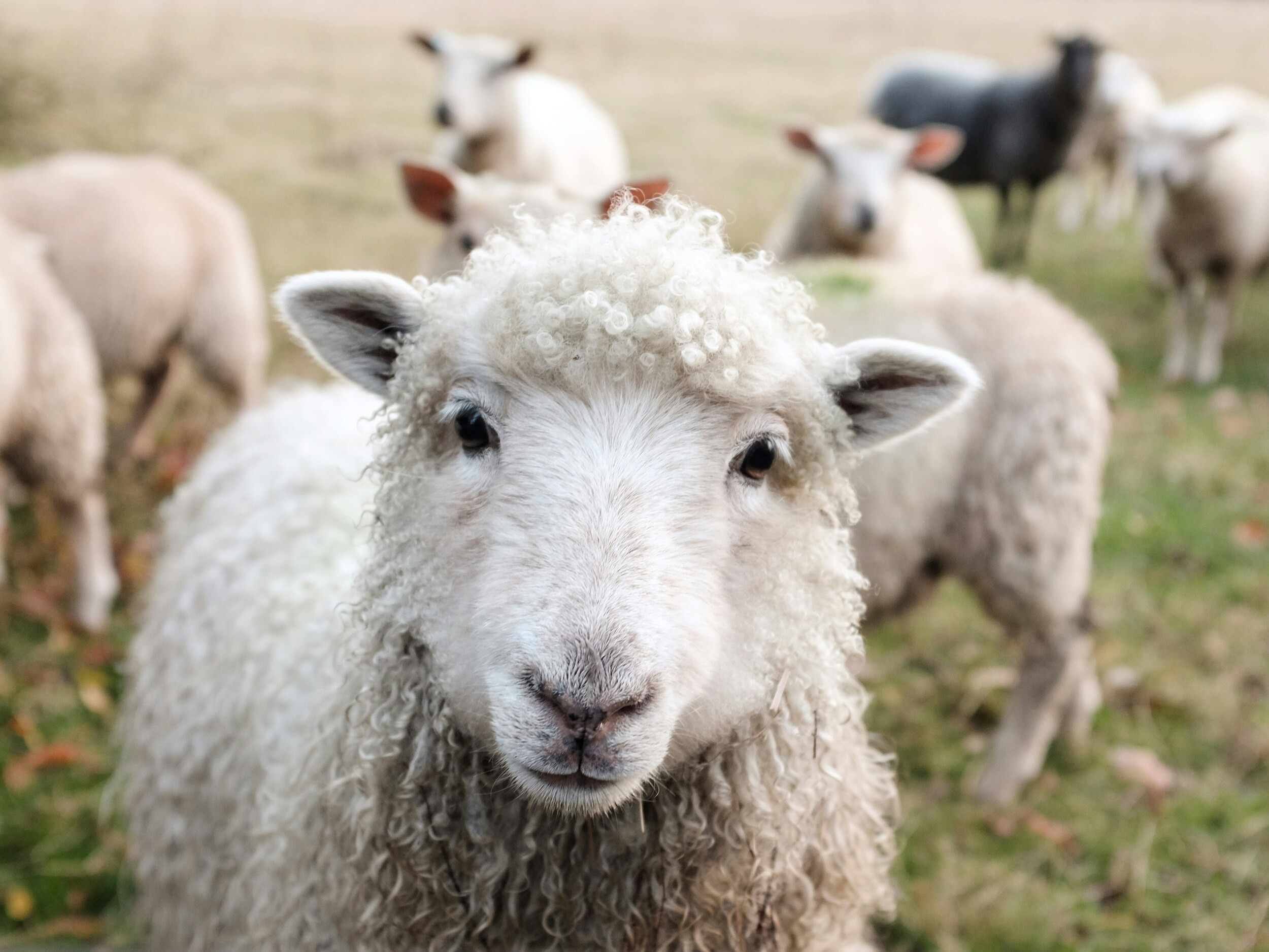
Now, sheep are not the rocket scientists of the animal kingdom. My people were farmers and I have been around sheep just enough to know you get dumber standing near them. So when Scripture calls us the sheep of his pasture, part of me thinks, Lord, could we not upgrade slightly? German shepherds, perhaps?
But it is the right word. Wandering off from the shepherd is not merely wayward and not merely rebellious. It is stupid, because away from him you are defenseless and everything that hunts you knows it. We have to admit that, or we will never know our need of him. By ourselves, scattered and lost. In him, found and gathered.
And understand — he did not have to stay. At that mockery of a trial the witnesses could not get their stories straight; had he simply said none of this is true and they cannot prove it, the Sanhedrin would have had to release him. Pilate asked him directly whether he had anything to say in his own defense. He is fully God and fully man, and do not kid yourself about the man: he must have been sorely tempted to say enough, I will not suffer any more for these people. He was not tricked into the cross. He drank the cup his Father poured.
Alan Walker, an Australian pastor, was driving home through those rolling hills one afternoon when he noticed a hawk circling. Around the next bend he saw a flock of sheep, and one small one out on its own, and then the hawk dropping. He pulled the car onto the verge, ran out, and got the hawk off. When he turned the sheep over, she was dead.
Underneath her was a newborn lamb. Alive. Sheltered by her body, covered in her blood, because she had given her life so that it could live.
We are sheltered by a broken body. We are covered by his blood. He gave his life so that we might live.