



Holidays
Thanksgiving: A Day of Gratitude, Not a Day of Mourning
Thanksgiving began as a public acknowledgment of God's goodness, not a celebration of conquest. Pastor James traces it from 1 Chronicles 29 to Washington and Lincoln, and gives your family a challenge for the table.

Photo: Chad Montgomery / Unsplash (CTrqyKtj9ec)
Somewhere between carving the turkey, watching football, and gathering with family, Americans would do well to remember why we celebrate Thanksgiving in the first place.
In recent years, activists and even some civic leaders have sought to redefine Thanksgiving as a “National Day of Mourning.” They argue that celebrating Thanksgiving overlooks the injustices of our nation’s past.
But must we deny the goodness of God in order to acknowledge the sinfulness of man? Must we abandon gratitude because our history is imperfect?
Absolutely not.
Thanksgiving was not established as a celebration of conquest, but as an acknowledgment of the goodness and providence of Almighty God. That is a heritage worth remembering, preserving, and passing on to our children.
A Nation Called to Give Thanks
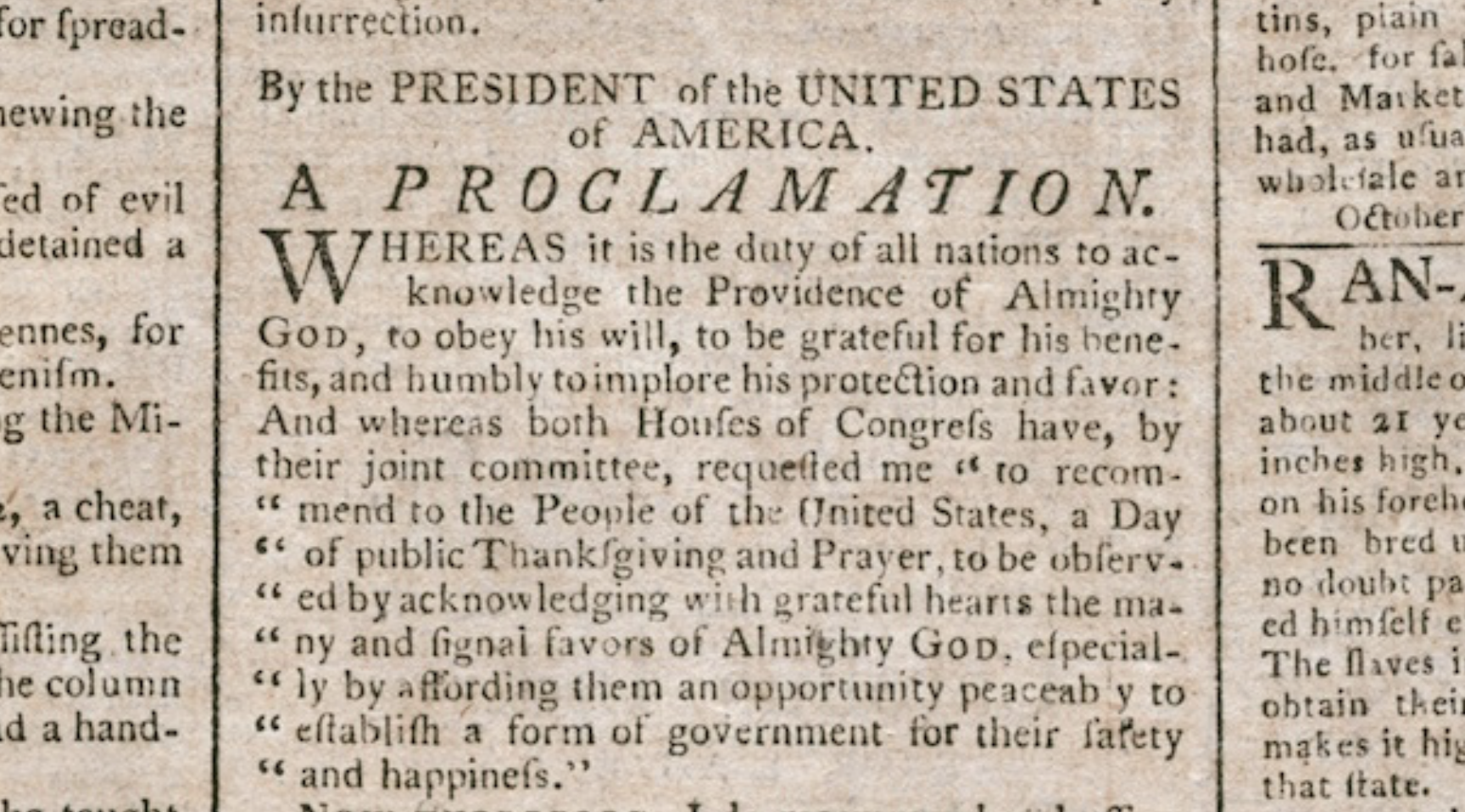
In 1789, at the request of Congress, President George Washington issued his first national Thanksgiving proclamation, calling Americans to a day of public thanksgiving and prayer in recognition of “the many signal favors of Almighty God.”
Washington called upon the nation to acknowledge the “great and glorious Being, who is the beneficent Author of all the good that was, that is, or that will be.”
Nearly seventy-five years later, in the midst of the Civil War, President Abraham Lincoln renewed that call. On October 3, 1863, while our nation was tearing itself apart, Lincoln established an annual national observance of Thanksgiving, recognizing the blessings Americans continued to enjoy as “the gracious gifts of the Most High God.”
Think about that for a moment. Even amid one of the darkest chapters in American history, Lincoln recognized that there was still good reason to give thanks.
Our national tradition of Thanksgiving was rooted in a public acknowledgment of our dependence upon God.
Thanksgiving Is Fundamentally Biblical
Long before America existed, God’s people understood that every blessing ultimately came from the hand of their Creator.
In 1 Chronicles 29, after the people generously contributed toward the building of the temple, King David stood before the assembly and declared:
“Both riches and honor come from you, and you rule over all. … And now we thank you, our God, and praise your glorious name.” (1 Chronicles 29:12–13)
David goes on to say:
“For all things come from you, and of your own have we given you.” (1 Chronicles 29:14)
The following day, the people ate and drank before the Lord with great joy.
Sounds a little like Thanksgiving, doesn’t it?
Gathering together, enjoying the abundance of God’s provision, and publicly acknowledging His goodness is not merely an American tradition. It is a thoroughly biblical practice.
Seeing God’s Providence in Our History
We see a remarkable picture of God’s providence in the story of the Pilgrims.
Having sought religious freedom, they arrived on these shores only to experience unimaginable hardship. Disease, starvation, and a brutal winter claimed the lives of nearly half their community.
Yet even in their suffering, God provided.
Consider the remarkable story of Squanto. Having been kidnapped, taken across the Atlantic, and eventually returned to his homeland, he possessed the very language and knowledge that would help the struggling Pilgrims survive. His assistance, alongside the cooperation of the Wampanoag people, helped make possible the shared harvest celebration of 1621.
What some might dismiss as historical coincidence, Christians recognize as the mysterious providence of God.
That gathering was not a declaration of racial superiority or a celebration of conquest. It was a remarkable moment of cooperation and shared abundance following a season of tremendous suffering.
It is a moment worth remembering.
Gratitude Does Not Require Historical Amnesia
Of course, the history of America is not without its sins. Broken treaties, the unjust treatment of Native Americans, slavery, and other failures are undeniable parts of our national story.
But historical integrity requires us to tell the whole story.
North America was not a peaceful paradise before Europeans arrived. Centuries before the Pilgrims ever set foot on these shores, Native American tribes engaged in warfare, territorial conquest, tribal rivalries, the enslavement of captives, and, in certain societies, practices involving cannibalism. Archaeological evidence documents massacres, fortified settlements, and violent conflicts that long predate European settlement.
Bloodshed did not begin with the arrival of Europeans. Neither did human oppression, territorial conquest, or man’s desire for power.
To portray precolonial America as a land of uninterrupted peace is no more historically accurate than portraying every European settler as an oppressor. Both narratives fail to account for the complexity of history and the biblical reality of human nature.
As Christians, we should understand this better than anyone. The doctrine of total depravity teaches us that every aspect of human nature has been affected by the Fall. No race, nation, tribe, or civilization is exempt from the problem of sin.
Sin is not a uniquely American problem, a uniquely European problem, or a uniquely Native American problem. It is a human problem.
We should pursue justice where injustice exists, but we must resist a mindset that assigns personal guilt or moral innocence on the basis of ancestry alone. Our responsibility is to live faithfully, pursue righteousness, love our neighbors, and steward the blessings God has entrusted to us.
We should neither romanticize our nation’s history nor reduce it to a catalogue of its failures. We can acknowledge the injustices of the past while celebrating the extraordinary blessings of religious liberty, opportunity, generosity, and freedom that generations of Americans have enjoyed.
We do not need to pretend that America has been perfect to recognize that God has been good.
Our Greatest Reason to Give Thanks
As Christians, our gratitude ultimately transcends our nationality, our circumstances, and even the abundance on our tables.
Our greatest reason for thanksgiving is the gospel of Jesus Christ.
While we were still sinners, Christ died for us. He bore the judgment we deserved, rose victoriously from the grave, and secured eternal life for all who trust in Him.
The gospel brings together people from every tribe, tongue, and nation, not through a denial of their past, but through the transforming power of God’s grace.
If God never gave us another earthly blessing, we would still have more than enough reason to spend eternity giving Him thanks.
And yet, in His kindness, He continues to bless us in countless ways.
A Thanksgiving Challenge for Your Family
Today, before your family sits down to enjoy Thanksgiving dinner, I want to challenge you to do something a little different.
Take a few minutes to read George Washington’s Thanksgiving Proclamation of 1789 aloud to your family.
Remarkably, Washington designated Thursday, November 26, as that national day of thanksgiving, the very same day we celebrate Thanksgiving this year, 237 years later.
Let your children hear, in the words of our first president, why our nation was called to give thanks. Then go around the table and have each person share something for which they are particularly grateful to God this year. Close by praying together as a family.
Let’s teach the next generation not merely to enjoy God’s blessings, but to acknowledge the One who gives them.
Gather your family. Enjoy the feast. Remember our history. Pray for our nation. Serve those in need. And above all, give glory to God.
We can mourn the sins of our past without surrendering our gratitude for the blessings of our present.
Thanksgiving is not a declaration of America’s perfection. It is an acknowledgment of God’s goodness.
And that is something worth celebrating.
“Oh give thanks to the Lord, for he is good, for his steadfast love endures forever!” (Psalm 107:1)
Happy Thanksgiving!
Frequently asked questions
Is Thanksgiving a biblical holiday?
Why do Americans celebrate Thanksgiving?
Should Christians treat Thanksgiving as a National Day of Mourning?
What date did George Washington set for the first national Thanksgiving under the Constitution?
How can my family celebrate Thanksgiving in a Christ-centered way?
Pastoral writing from the team at Christchurch Miami — a faith family on mission in Kendall, Miami.