


History
George Washington's 1789 Thanksgiving Proclamation
Before Thanksgiving was a holiday, it was a prayer. Read George Washington's 1789 proclamation, the first under the new Constitution, thanking God for liberty and asking pardon for the nation's sins.
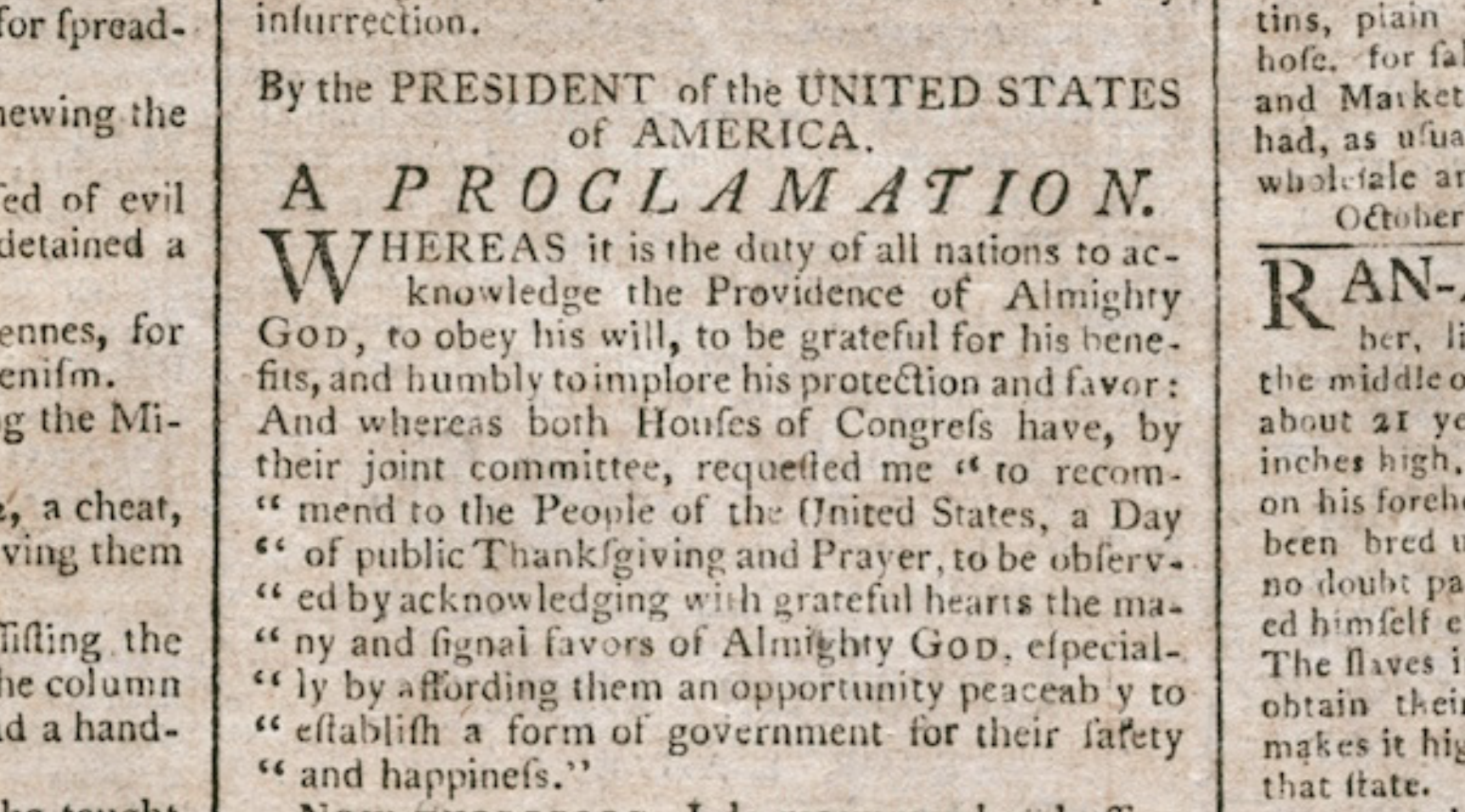
Whereas it is the duty of all nations to acknowledge the providence of Almighty God, to obey His will, to be grateful for His benefits, and humbly to implore His protection and favor; and Whereas both Houses of Congress have, by their joint committee, requested me “to recommend to the people of the United States a day of public thanksgiving and prayer, to be observed by acknowledging with grateful hearts the many and signal favors of Almighty God, especially by affording them an opportunity peaceably to establish a form of government for their safety and happiness:“
Now, therefore, I do recommend and assign Thursday, the 26th day of November next, to be devoted by the people of these States to the service of that great and glorious Being who is the beneficent author of all the good that was, that is, or that will be; that we may then all unite in rendering unto Him our sincere and humble thanks for His kind care and protection of the people of this country previous to their becoming a nation; for the signal and manifold mercies and the favorable interpositions of His providence in the course and conclusion of the late war; for the great degree of tranquility, union, and plenty which we have since enjoyed; for the peaceable and rational manner in which we have been enabled to establish constitutions of government for our safety and happiness, and particularly the national one now lately instituted; for the civil and religious liberty with which we are blessed, and the means we have of acquiring and diffusing useful knowledge; and, in general, for all the great and various favors which He has been pleased to confer upon us.
And also that we may then unite in most humbly offering our prayers and supplications to the great Lord and Ruler of Nations and beseech Him to pardon our national and other transgressions; to enable us all, whether in public or private stations, to perform our several and relative duties properly and punctually; to render our National Government a blessing to all the people by constantly being a Government of wise, just, and constitutional laws, discreetly and faithfully executed and obeyed; to protect and guide all sovereigns and nations (especially such as have shown kindness to us), and to bless them with good governments, peace, and concord; to promote the knowledge and practice of true religion and virtue, and the increase of science among them and us; and, generally to grant unto all mankind such a degree of temporal prosperity as He alone knows to be best.
Given under my hand, at the city of New York, the 3d day of October, A.D. 1789.
(signed) G. Washington
Frequently asked questions
What is George Washington's 1789 Thanksgiving Proclamation?
It is the first national Thanksgiving Proclamation issued under the new U.S. Constitution. Both Houses of Congress, through a joint committee, requested President George Washington to recommend 'to the people of the United States a day of public thanksgiving and prayer, to be observed by acknowledging with grateful hearts the many and signal favors of Almighty God,' especially the opportunity to peaceably establish a form of government for their safety and happiness. Washington responded by recommending Thursday, November 26, 1789, as that day. He signed it 'at the city of New York, the 3d day of October, A.D. 1789.' The proclamation grounds the new nation's gratitude in the providence of Almighty God — explicitly naming God as 'the beneficent author of all the good that was, that is, or that will be.' It is one of the clearest founding-era statements of America's posture of dependence on God.
What did Washington say Americans should be thankful for?
Washington's proclamation lists specific reasons for national thanksgiving. He calls Americans to render sincere and humble thanks to God for: his kind care and protection of the people of this country before they were even a nation; the signal and manifold mercies and favorable interpositions of his providence in the course and conclusion of 'the late war' (the Revolutionary War); the great degree of tranquility, union, and plenty enjoyed since; the peaceable and rational manner in which Americans had been enabled to establish constitutions of government for their safety and happiness — particularly the new national one; the civil and religious liberty with which the nation was blessed; the means available for acquiring and diffusing useful knowledge; and 'in general, for all the great and various favors which He has been pleased to confer upon us.' It is a thoroughly God-centered list — providence, liberty, peace, and knowledge, all attributed to the same Giver.
What did Washington ask Americans to pray for?
Alongside thanksgiving, Washington called Americans to humble prayer and supplication. He asked the nation to beseech God to pardon 'our national and other transgressions' — a striking acknowledgment of corporate sin. He asked God to enable all Americans, in public and private stations, to perform their duties properly and punctually; to render the National Government a blessing to all the people by being 'a Government of wise, just, and constitutional laws, discreetly and faithfully executed and obeyed'; to protect and guide all sovereigns and nations — 'especially such as have shown kindness to us' — and to bless them with good governments, peace, and concord; to promote the knowledge and practice of true religion and virtue, and the increase of science among them and us; and 'generally to grant unto all mankind such a degree of temporal prosperity as He alone knows to be best.' It is a remarkably outward-looking prayer — for the nation, for allies, for the world.
Why does the Thanksgiving Proclamation matter for Christians today?
Washington's proclamation models a posture our culture has largely lost — a nation publicly acknowledging that its blessings come from God, that it has a duty to thank him, that it has transgressions to confess, and that it depends on his providence for everything good. It opens with the conviction 'that it is the duty of all nations to acknowledge the providence of Almighty God, to obey His will, to be grateful for His benefits, and humbly to implore His protection and favor.' For Christians today, the proclamation is more than a historical document — it is a pattern. Thanksgiving isn't just a meal or a four-day weekend. It's a deliberate act of worship that names God as the source of every good thing, asks his pardon for national and personal sin, and prays for the flourishing not just of our own nation but of all mankind. That's a worth recovering.
JR
Pastoral writing from the team at Christchurch Miami — a faith family on mission in Kendall, Miami.