


Science & Creation
How Should Christians Read Genesis 1?
Why I believe Genesis describes real history, and why Christians can talk about the six days, the age of the earth and science with humility.

Photo: Stefan Szankowski / Unsplash (YEwhTVW-lG0)
Few chapters of the Bible stir up more questions than Genesis 1.
Are the six days ordinary days? How old is the earth? What about evolution? Does believing Genesis put Christians at odds with science? And do Christians have to agree about all of it?
Let me say this up front. I’m not a scientist, and I won’t pretend to have expertise I don’t have. I’m a pastor who believes the Word of God is true. So when I come to Genesis, my first question isn’t, “How can I make this fit the position I already hold?” It’s, “What does the text actually say?”
That’s the safest place to begin.
Is Genesis 1 meant to describe real history?
I believe it is.
Genesis 1 is beautifully written. Days 1–3 form the world, and days 4–6 fill what God formed. Day one lines up with day four, day two with day five, and day three with day six. It’s careful, and it’s theologically rich.
But literary artistry doesn’t make the events nonhistorical.
Genesis begins, “In the beginning, God created the heavens and the earth” (Genesis 1:1).
Then, over and over, the chapter shows God speaking, something happening, God seeing that it was good, and “evening and morning” marking one day after another.
My instinct is to let those words carry their ordinary meaning, unless Scripture itself gives me a compelling reason to read them differently.
Were the six days ordinary days?
That’s where I land.
One of the strongest reasons is that Scripture later reads Genesis this way. In the Ten Commandments, God grounds a seven-day week in creation: “For in six days the LORD made heaven and earth, the sea, and all that is in them, and rested on the seventh day” (Exodus 20:11).
The pattern is intentionally straightforward. God worked six days and rested on the seventh. So His people work six days and rest on the seventh.
Could God have created everything in an instant? Of course. Could He have taken billions of years? Certainly. But the question isn’t what God could have done. The question is what God tells us He did.
And when I read Genesis alongside Exodus, I’m persuaded the most natural reading is six ordinary days.
Does that mean the earth is young?
I believe the Bible’s timeline points in that direction.
When I read Genesis 1 together with the genealogies and the rest of Scripture’s history, a creation measured in thousands of years is more persuasive to me than one measured in billions.
I hold an exact number more loosely. Some people say six thousand years. Others calculate a little differently. I’m more confident in the basic biblical framework than I am in putting a precise birthday on the earth.
And that distinction matters. I can have strong convictions about the text without believing every Christian has to reach every conclusion with exactly the same level of certainty.
Faithful Christians who love Jesus, believe the Bible, and hold to the gospel have disagreed about the age of the earth and the length of the creation days.
We should be able to have that conversation without questioning one another’s salvation or intelligence.
Were Adam and Eve real people?
Here’s where the rest of Scripture becomes especially important.
Jesus speaks of God making humanity “male and female” from the beginning (Mark 10:6). Paul builds his explanation of sin and salvation around a real Adam and a real Christ: “Sin came into the world through one man” (Romans 5:12). Later he contrasts “the first man Adam” with Jesus, “the last Adam” (1 Corinthians 15:45).
That’s why I believe Adam and Eve were real, specially created human beings and the parents of the human race. I don’t believe humanity is ultimately the accidental result of an unguided evolutionary process.
The Bible’s story of redemption is tied to its story of creation. A real creation. A real fall. A real Adam. And ultimately, a real Savior who steps into history to redeem Adam’s fallen race.
Does believing Genesis put Christianity against science?
It shouldn’t.
Christians should love honest scientific investigation. We believe the universe was created by an intelligent God who made an orderly world, a world that can actually be studied.
Science is not the enemy of Christianity.
At the same time, science involves human beings interpreting evidence, building models, challenging earlier conclusions, and sometimes changing those conclusions as new information comes in. That’s not a defect. That’s part of how scientific investigation works.
Scripture and science also answer some different kinds of questions. Genesis isn’t trying to be a modern laboratory manual. But I don’t think we should assume that whenever Scripture makes a claim about the physical history of the world, that claim has to be reinterpreted to fit whichever scientific model is dominant right now.
I want to listen carefully to both God’s world and God’s Word, while letting God’s Word have the final authority.
Aren’t we all bringing assumptions to the text?
Yes.
Christians do. Scientists do. Skeptics do. I do.
None of us comes to these questions from a completely neutral place. And none of us was standing there at the beginning of the universe, taking notes.
That should make all of us humble.
For me, it also means resisting the urge to put a filter over Scripture before I’ve let Scripture speak. Instead of starting with what Genesis can’t mean, I want to start by asking what the text appears to be saying, and then let the rest of Scripture help me interpret it.
When I do that, here’s where I come out:
- God created everything out of nothing.
- He did it in six ordinary days.
- Adam and Eve were real, historical people.
- Biblical history is better understood on a timeline of thousands of years than billions.
I realize sincere Christians reach different conclusions, and I’m happy to talk about those differences. Christianity isn’t fragile, and honest questions don’t threaten God.
Who gets the first word?
Maybe the most important question Genesis asks isn’t “How old is the earth?”
It’s this: Who gets the first word?
Genesis answers before anything else exists: “In the beginning, God.”
And if God gets the first word in creation, He deserves the final word in our lives. Our bodies. Our relationships. Our work. Our sexuality. Our money. Our future. Our fears. Every square inch belongs to the One who made us.
That’s ultimately why Genesis matters.
The Creator has spoken.
Our task is to listen.
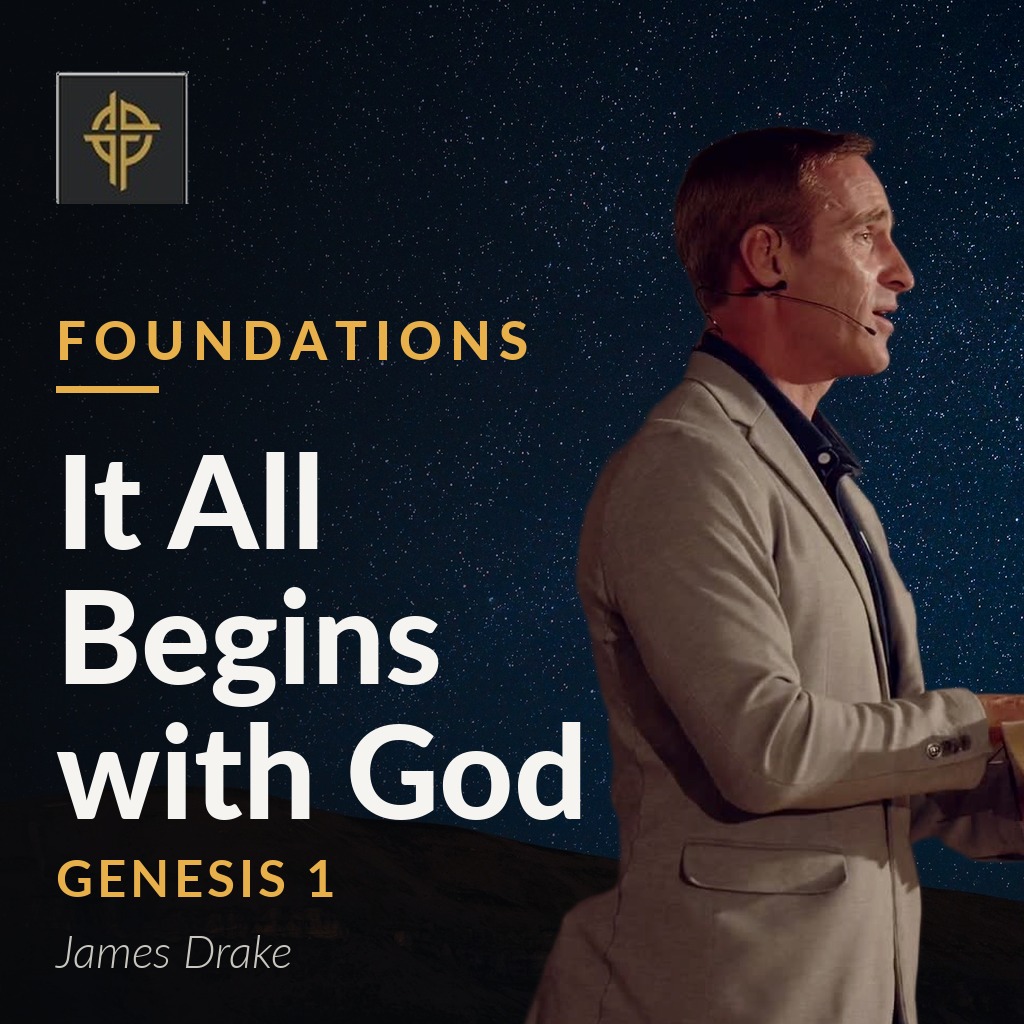
We’re walking through Genesis 1–11 together in our Foundations series. If you missed the first message, you can watch It All Begins with God.
Frequently asked questions
How should Christians read Genesis 1?
Were the six days of creation ordinary days?
How old is the earth according to the Bible?
Were Adam and Eve real people?
Does believing Genesis put Christianity against science?
Do Christians have to agree about the age of the earth?
Pastoral writing from the team at Christchurch Miami — a faith family on mission in Kendall, Miami.