
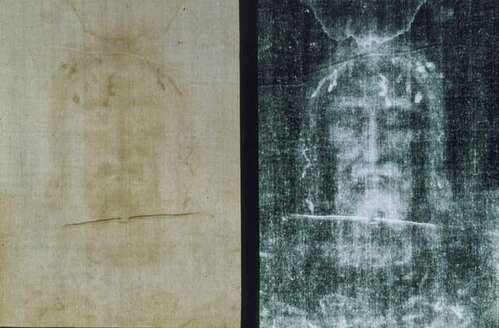
The Shroud of Turin*
Recently a young friend asked me what I thought about the Shroud of Turin. The Shroud of Turin, in case you’re not familiar with it, is purported to be the burial cloth of Jesus.
National Geographic Magazine (June 1980) labeled it: “One of the most perplexing enigmas of modern times.”
To be clear, neither my faith nor the Christian faith stands or falls on whether or not the Shroud is authentic. Personally, I’ve always been agnostic about it. But at the prompting of my young friend I did a more in-depth look at it, and here is a brief overview of some of what I learned.
What it is: A centuries-old linen cloth bearing the image of a crucified man. The faint image on the cloth depicts a gaunt man 5’6’-6’1”. He has markings on his body corresponding to the way the Bible describes the trials and crucifixion of Jesus – thorn marks on his head, bruises on his shoulders, lacerations on his back. It is housed in the Cathedral of St. John the Baptist in Turin, Italy. And it is the most studied artifact in human history.
The age of the Shroud: In 1988 an international team of scientists dated the Shroud using the carbon-14 technique. They concluded that the fabric originated between 1260 AD and 1390 AD. This would rule it out as the burial shroud of Christ and led many people to dismiss the Shroud as a clever medieval hoax.
But some experts challenged this conclusion on various grounds and also claimed that this study was not properly controlled because of contamination of the Shroud. Also, the samples they used were collected from a single location, and that piece may have been added to the Shroud later to repair it after it was burned in a fire in 1352 – which is roughly how hold that 1988 study said it was.
In the most recent study, researchers from Italy’s Institute of Crystallography applied a much more advanced X-ray technique to study the Shroud. That analysis dates the Shroud’s origin to the first century AD, supporting its authenticity.
Those researchers also found that their analysis of the material in the Shroud was consistent with the analysis of linens from Israel in the first century AD. But when the Shroud was compared with linens from the medieval period (1260-1390 AD) there was no similarity.
“We can conclude for now that the Shroud image is that of a real human form of a scourged, crucified man. It is not the product of an artist.” – Shroud of Turin Research Project Final Report, 1981.
Further:
•The dimensions of the cloth match the measurement used by Jewish law and custom for a burial cloth.
•The composition of the cloth: The material of the threads is consistent with known first-century plants.
•It has pollen grains on it unique to Judea.
•There are Roman coins on the eyes in the image, minted by Pontius Pilate in 29 AD.
There are real blood stains on it:
•Like the markings on his body, they match the descriptions of the sufferings of Jesus in the Gospels.
•The blood type is a very rare AB+. Apparently people with this blood type are universal plasma donors.
•The stains match descriptions of the Passion of Jesus in the Gospels.
•The blood particles reveal a high content of bilirubin. This is significant for two reasons: 1. It is consistent with bodily response to extreme trauma (so a dead body could not have been used to create the image); and 2. Blood with high bilirubin content stays red over time and does not turn dark brown (consistent with stains on the Shroud).
•The blood imprints precede the formation of the image.
•There are correspondences with another relic, the Sudarium Christi: similar pollen grains; 124 exact matches to wounds on the Shroud; the same AB blood type.
•The Shroud is a precise photographic negative (on non-photographically sensitive cloth). This obviously is hundreds of years before cameras and photographs and negatives were invented.
•The image was not produced by paint, dye, vapors, or scorching.
•The image is unique: no other image in the world has its distinctive characteristics. The only known explanation for the formation of the image is an intense burst of vacuum ultraviolet radiation (equivalent to the output of 14K excimer lasers) emitted from every three-dimensional point of the body in the Shroud. (Emphases added.)
Skeptics abound, but so far no one has come up with a credible explanation of how the relic might have been forged. And in spite of a $1 million offer, no one has yet produced a similar object.
Again: Neither my faith nor the Christian faith depends on whether or not the Shroud is authentic, but I’m leaning more in the direction of it being authentic … until someone can explain how it was made.
The Shroud is either the actual burial cloth of Jesus Christ, or the most ingenious, elaborate hoax in human history.
What do you think?
Kent
*Compiled from numerous sources.
National Geographic Magazine (June 1980) labeled it: “One of the most perplexing enigmas of modern times.”
To be clear, neither my faith nor the Christian faith stands or falls on whether or not the Shroud is authentic. Personally, I’ve always been agnostic about it. But at the prompting of my young friend I did a more in-depth look at it, and here is a brief overview of some of what I learned.
What it is: A centuries-old linen cloth bearing the image of a crucified man. The faint image on the cloth depicts a gaunt man 5’6’-6’1”. He has markings on his body corresponding to the way the Bible describes the trials and crucifixion of Jesus – thorn marks on his head, bruises on his shoulders, lacerations on his back. It is housed in the Cathedral of St. John the Baptist in Turin, Italy. And it is the most studied artifact in human history.
The age of the Shroud: In 1988 an international team of scientists dated the Shroud using the carbon-14 technique. They concluded that the fabric originated between 1260 AD and 1390 AD. This would rule it out as the burial shroud of Christ and led many people to dismiss the Shroud as a clever medieval hoax.
But some experts challenged this conclusion on various grounds and also claimed that this study was not properly controlled because of contamination of the Shroud. Also, the samples they used were collected from a single location, and that piece may have been added to the Shroud later to repair it after it was burned in a fire in 1352 – which is roughly how hold that 1988 study said it was.
In the most recent study, researchers from Italy’s Institute of Crystallography applied a much more advanced X-ray technique to study the Shroud. That analysis dates the Shroud’s origin to the first century AD, supporting its authenticity.
Those researchers also found that their analysis of the material in the Shroud was consistent with the analysis of linens from Israel in the first century AD. But when the Shroud was compared with linens from the medieval period (1260-1390 AD) there was no similarity.
“We can conclude for now that the Shroud image is that of a real human form of a scourged, crucified man. It is not the product of an artist.” – Shroud of Turin Research Project Final Report, 1981.
Further:
•The dimensions of the cloth match the measurement used by Jewish law and custom for a burial cloth.
•The composition of the cloth: The material of the threads is consistent with known first-century plants.
•It has pollen grains on it unique to Judea.
•There are Roman coins on the eyes in the image, minted by Pontius Pilate in 29 AD.
There are real blood stains on it:
•Like the markings on his body, they match the descriptions of the sufferings of Jesus in the Gospels.
•The blood type is a very rare AB+. Apparently people with this blood type are universal plasma donors.
•The stains match descriptions of the Passion of Jesus in the Gospels.
•The blood particles reveal a high content of bilirubin. This is significant for two reasons: 1. It is consistent with bodily response to extreme trauma (so a dead body could not have been used to create the image); and 2. Blood with high bilirubin content stays red over time and does not turn dark brown (consistent with stains on the Shroud).
•The blood imprints precede the formation of the image.
•There are correspondences with another relic, the Sudarium Christi: similar pollen grains; 124 exact matches to wounds on the Shroud; the same AB blood type.
•The Shroud is a precise photographic negative (on non-photographically sensitive cloth). This obviously is hundreds of years before cameras and photographs and negatives were invented.
•The image was not produced by paint, dye, vapors, or scorching.
•The image is unique: no other image in the world has its distinctive characteristics. The only known explanation for the formation of the image is an intense burst of vacuum ultraviolet radiation (equivalent to the output of 14K excimer lasers) emitted from every three-dimensional point of the body in the Shroud. (Emphases added.)
Skeptics abound, but so far no one has come up with a credible explanation of how the relic might have been forged. And in spite of a $1 million offer, no one has yet produced a similar object.
Again: Neither my faith nor the Christian faith depends on whether or not the Shroud is authentic, but I’m leaning more in the direction of it being authentic … until someone can explain how it was made.
The Shroud is either the actual burial cloth of Jesus Christ, or the most ingenious, elaborate hoax in human history.
What do you think?
Kent
*Compiled from numerous sources.
Search
Recent
What Happens When We Die?
July 2nd, 2026
America 250: The Declaration of Independence
July 2nd, 2026
In Honor of Independence Day
July 1st, 2026
Why Are There Different Bibles? (Can I Trust the Bible? Part 2)
June 29th, 2026
Should Christians Support Israel? What the Bible Actually Says
June 22nd, 2026
Archive
2026
January
Going the Second Mile: Living Beyond What the World ExpectsGood VibrationsLearning to Love Your Enemies: Lessons from the Second MileThoughts on Martin Luther King Jr.’s “Letter From A Birmingham Jail”Human TraffickingWhy Do You Give? Living for God's Approval Rather Than Man's ApplauseHow to Pray Authentically: Lessons from the Lord's PrayerBlack History Month
February
March
When Following Jesus Gets Hard: Finding God's Guidance Through PrayerThe Golden Rule: A New Way of LivingThe Real Saint Patrick*Earth in the BalanceBeware of False Prophets: How to Recognize Truth from DeceptionBuilding Your Life on the Right Foundation: A Warning About False FaithEarth in the Balance, Part 2True vs False Christianity: How to Know If Your Faith Is RealSummer SolsticeMoonstruckDetails, DetailsThe Week that Changed Everything: Understanding Palm Sunday
April
Passover: Covered By The BloodIt's Sunday, But Friday is ComingDid Jesus Really Rise from the Dead? | Road to Emmaus ExplainedThe Shroud of Turin*Did Jesus Really Rise From the Dead? The Evidence From 1 Corinthians 15You Are Salt and Light: Why the Resurrection Still MattersWhat Does the Bible Say About Anxiety?Should Christians Be Christian Nationalists?
May
Don't All Religions Lead to God? Why Christianity Is DifferentCan I Trust the Bible? Evidence from the ManuscriptsWhy Doesn't God Always Heal? A Chaplain's Field DevotionAre Science and Christianity CompatibleHow Do You Pass Faith to Your Kids When Life Won't Slow Down?Are You Covered? The Passover, the Cross, and the True LambCommunity of the Broken (Life is Short. Live It Well.)
How Will You Invest Your Summer?How to Study the BibleLoving Muslims, Following Jesus: A Pastor and Army Chaplain on Islam
June
How the Gospel Changes the Way You Handle Difficult PeopleWhat Does the Bible Say About Success?What does "In the World, But Not of it." Mean?Why Is the Church Full of Hypocrites?Brian Wilson, Faith & the Music of the SpheresCatholic vs. Protestant: What's the Difference?What is your GiantShould Christians Support Israel? What the Bible Actually SaysWhy Are There Different Bibles? (Can I Trust the Bible? Part 2)
2025
October
November
Mission Must Be Our Mindset: Living as Ambassadors for ChristWhat Does It Mean to Worship God in Spirit and Truth?Just WarWhat Do We Have To Be Thankful For?What Did Jesus Really Mean? Understanding the BeatitudesGeorge Washington's 1789 Thanksgiving ProclamationYou Are Salt and Light: How to Live as Kingdom Citizens in a Dark WorldUnderstanding Jesus and the Law: Why Christ Came to Fulfill, Not Abolish
December
Finding Peace in the Midst of Christmas Chaos: What Jesus Taught About AngerUnderstanding Jesus' Teaching on Lust and Adultery: A Christmas MessageA Christmas ParableWinter SolsticeThe Quiet Faithfulness of Joseph: A Christmas Message of Trust and ObedienceWhy Your Word Should Be Your Bond: Jesus' Teaching on Truth and Integrity
10 Comments
So it sounds like you came around from your previous skepticism regarding its authenticity??
n
nI’ve always wondered myself and I appreciate very much your research and thoughts on the matter. Thank you, Kent.
First, you're welcome. Thank you for reading this and posting your comment.
n
nSecond, yes, I am leaning toward believing in its authenticity. Until someone, somewhere can take that million-dollar challenge and show us how it could possibly have been done, whether it was in the 14th, 13th or 1st Century, I think we are driven (along with all the other supporting evidence) to conclude this is the burial cloth which covered Jesus - for a few short days.
This is another dear reassurance of the truth of scripture - there are so many. Thank you Kent for taking the time to look at this His-toric evidence and share it with us.
Thanks, Val. I appreciate your comment.
Coming soon…this article in Spanish for our LOGOI family. Very good Kent! So very interesting and we all are curious. I have to smile at these incredible mysteries. Now, what about Noah’s ark?
Muy bien, Jefe Grande del Ministerio LOGOI!
n
nAs for Noah's Ark ... I'll leave that one for you.
I believe it's the actual burial cloth of Jesus Christ. And yet, like you, my faith/the Christian faith does not depend on whether the Shroud is authentic or not.
Roger that, brother. It's just one more piece of historical support for what happened in that garden tomb outside Jerusalem that Sunday morning roughly 2000 years ago.
Hi, Kent.
n
nI very much appreciate your detailed research on this, especially about the dating methods arguments.
n
nA major question I've had about the Shroud's authenticity is this:
n
nWhy is the image of the deceased body properly proportioned rather than distorted? If "Resurrection energy" somehow imprinted a bodily image onto the linen, why was it not distorted by the fact that the shroud draped over the bodily curves? If the top and bottom of the shroud were both completely flat and suspended parallel to the corpse, one could imagine that such a "Resurrection zap" would produce a properly proportioned image. But it is difficult to imagine a burial cloth suspended like that.
n
nThis concern is similar to the reasons that a Mercator projection of the globe produces a map of the globe that enlarges land masses as one moves away from the equator.
n
nHave you come across any insights on this matter?
n
nWarmly in Christ,
n
nRusty
n
Excellent insights, Rusty -- as usual. (BTW, sorry about those random "n's" that appear all over your comment as well as Gisela's, and the weird spacing. That's a design flaw on the part of our host, not us. We're trying to get that fixed.)
n
nCandidly, I had not thought about that at all. Having given it a little reflection, not a lot, my thought would be that since this obviously is a sui generis event, absolutely one-of-a-kind, with no other point of reference - i.e., we don't anybody else's burial shroud after he/she has been supernaturally resurrected to compare it to - the usual laws of physics don't apply here. If it is indeed Jesus' burial shroud, at the moment of his return to life by the power of God, who is to say how his body "passed through" that cloth and left his imprint? I'm afraid at that point we're looking at something where our understanding of normal, natural laws don't help us much.
n
nGreat question, though. Thanks again.
n
n